
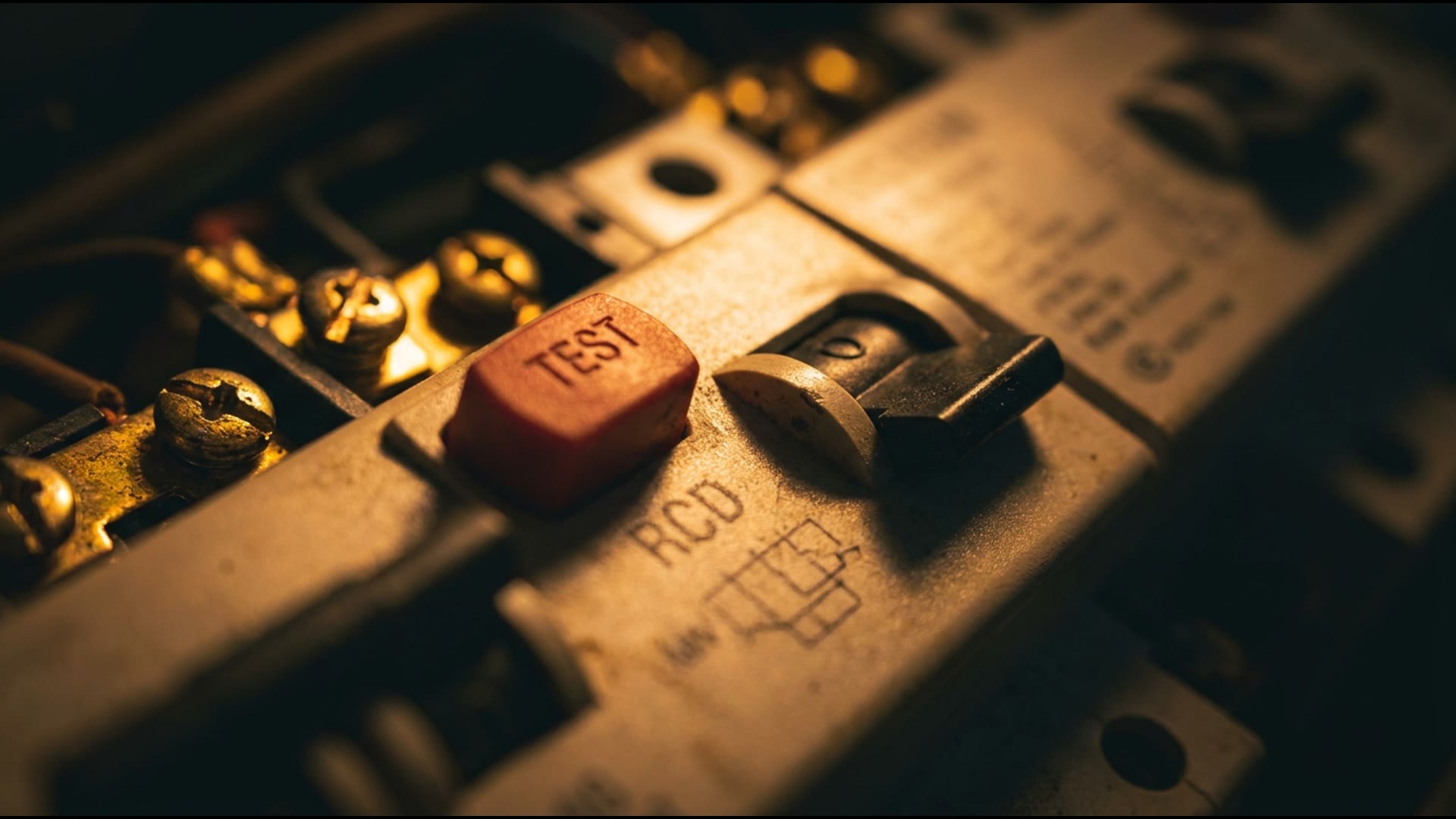
An RCD (residual current device, or safety switch) trips the circuit within milliseconds when it detects current leaking to earth, for example, through a person touching a live wire, or through a faulty appliance leaking through the metal casing. Without one, the same fault can be fatal. Current code requires RCD protection on every final sub-circuit in a residential switchboard, which is why we recommend a board upgrade rather than piecemeal RCD additions when the existing board is old.
What we install: per-circuit RCBOs (combined circuit breaker and RCD) on every sub-circuit, sized correctly for the cable and the load. Modern boards are populated with RCBOs across the entire board so every circuit has its own dedicated protection, if a fault on the laundry trips, the rest of the house stays on. The older arrangement of one RCD protecting four or five circuits is technically compliant on existing boards but it's not how we'd build a new one.
When we'd recommend dedicated RCD work rather than a full board upgrade: you've got a relatively modern board (post-2000) with circuit breakers, no RCDs on some circuits (typically lighting, hot water, oven), and you want to bring it up to current standard without replacing the whole board. We add the RCBOs, test each circuit, and leave you with a board where every protected device is doing its actual job.
We test every RCD we install with calibrated equipment, both the trip current and the trip time. An RCD that trips eventually but not within the required time is, in safety terms, no RCD at all. Test results are provided in writing with the compliance paperwork.
When to call us
- Existing board has circuit breakers but no RCDs on some circuits
- Home built in the 1990s or early 2000s with partial RCD coverage
- Landlord upgrading rental property to current safety standards
- Fault has highlighted that a circuit isn't actually protected
- Kitchen or bathroom renovation triggering a code-compliance upgrade
- Family with young children wanting belt-and-braces protection on every circuit
Our process
- Board assessment: We open the existing switchboard, identify what's protected by what, and note any circuits running without RCD coverage.
- Fixed quote: Per-circuit RCBO scope, any board space or sub-board work required, and the certificate at the end, all in writing.
- Install: Old single-pole breakers replaced with RCBOs sized correctly to the cable and load. Each circuit re-terminated and labelled.
- Calibrated testing: Every RCD tested for trip current (30mA) and trip time. Results recorded.
- Walkthrough: We show you which RCDs cover what, and how to safely test and reset them yourself.
- Certificate: Compliance paperwork issued and a copy left with you for your records.
Why choose Electrix all Blew
We're a family-run electrical business based in Bilgola Plateau. Over 38+ years on the Northern Beaches means we know the housing stock - weatherboard home, 1980s solid bricks, strata buildings - and what tends to fail in each.
We're licensed for electrical and air conditioning. We carry full public liability and contractor insurance. We turn up when we say we will, we call ahead when we're 20 minutes out, and we hold to 1-hour appointment windows.
Our 184 Google reviews sit at a 5.0 average. That's the result of doing the work properly the first time, not chasing reviews.
Frequently asked
What's the difference between a circuit breaker and an RCD?
A circuit breaker trips on overload or short circuit, too much current. An RCD trips on earth leakage, current going somewhere it shouldn't, usually through a person or a faulty appliance. You need both. An RCBO does both in one device.
Do all my circuits need to be on an RCD?
Current code requires RCD protection on every final sub-circuit. Older boards installed before that rule are technically compliant as-is but we'd recommend bringing them up to current standard, especially in homes with kids, pools or significant outdoor circuits.
My RCD keeps tripping, does it need replacing?
Sometimes, but more often the RCD is doing its job and there's an actual leakage fault on the circuit it protects. We test the RCD with calibrated equipment, then trace the leakage. Replacing the RCD without finding the fault just moves the problem.
Can you just add an RCD without replacing the whole board?
Yes, on most relatively modern boards. We swap individual breakers for RCBOs circuit by circuit. On very old boards with limited space or ceramic fuses, a full board upgrade is usually the better long-term call.
How often should I test the RCD?
Press the test button on each RCD every three months. If it doesn't trip, ring us. We also recommend a calibrated test every couple of years to confirm the trip time is still within spec.